|
A novel graphene structure
Graphene, a one-atom-thick film of carbon densely packed in a honeycomb crystal lattice, has been the hottest research topic in recent years due to its many extraordinary properties. Graphene is one of the strongest, lightest, most conductive and transparent materials. It has opened up many exciting new horizons in research and applications. However, despite all its intriguing properties, lacking a bandgap has limited graphene from some direct applications in electronics such as a channel material for field effect transistors (FET). Prof. Shen’s group has demonstrated a new graphene structure - closed edge bilayer graphene (CEBG). By heating bilayer graphene samples, the zigzag edges will close and form curved close structure naturally (Fig. 1). This structure may provide a simple and controllable method to engineer graphene electronics as the regulated edge states may critically change the overall electronic behaviors. AB-stacked CEBG has an energy bandgap due to pseudo spin interaction between the two layers (Fig. 2), which is critical for many potential graphene-based applications, e.g. high on-off ratio field effect transistors, solar cells. The results have been published in the inaugural issue of SCIENTIFIC REPORTS, by NATURE Publishing Group.
More details can be found at: http://www.nature.com/srep/2011/110614/srep00012/full/srep00012.html (Sci. Rep., 1, 12, 2011).
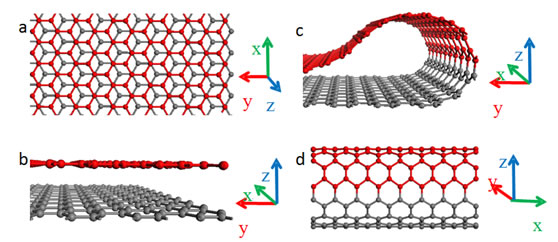
Figure 1 | Schematic atomic structure for AB-stacked BLG (x axis is along zigzag direction; y axis is along armchair direction; z axis is perpendicular to the basal plane.). a, Top view. b, Cross-section view along x-axis for open-edge BLG. c, Cross-section view along x-axis for closed-edges BLG. d, Cross-section view along y axis shows that the closed structure formed along zigzag edges is geometrically compatible.
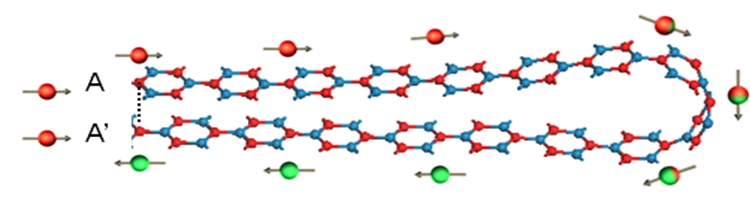
Figure 2 | Pseudospin interactions in AB-stacked CEBG.
|